Smart Capture
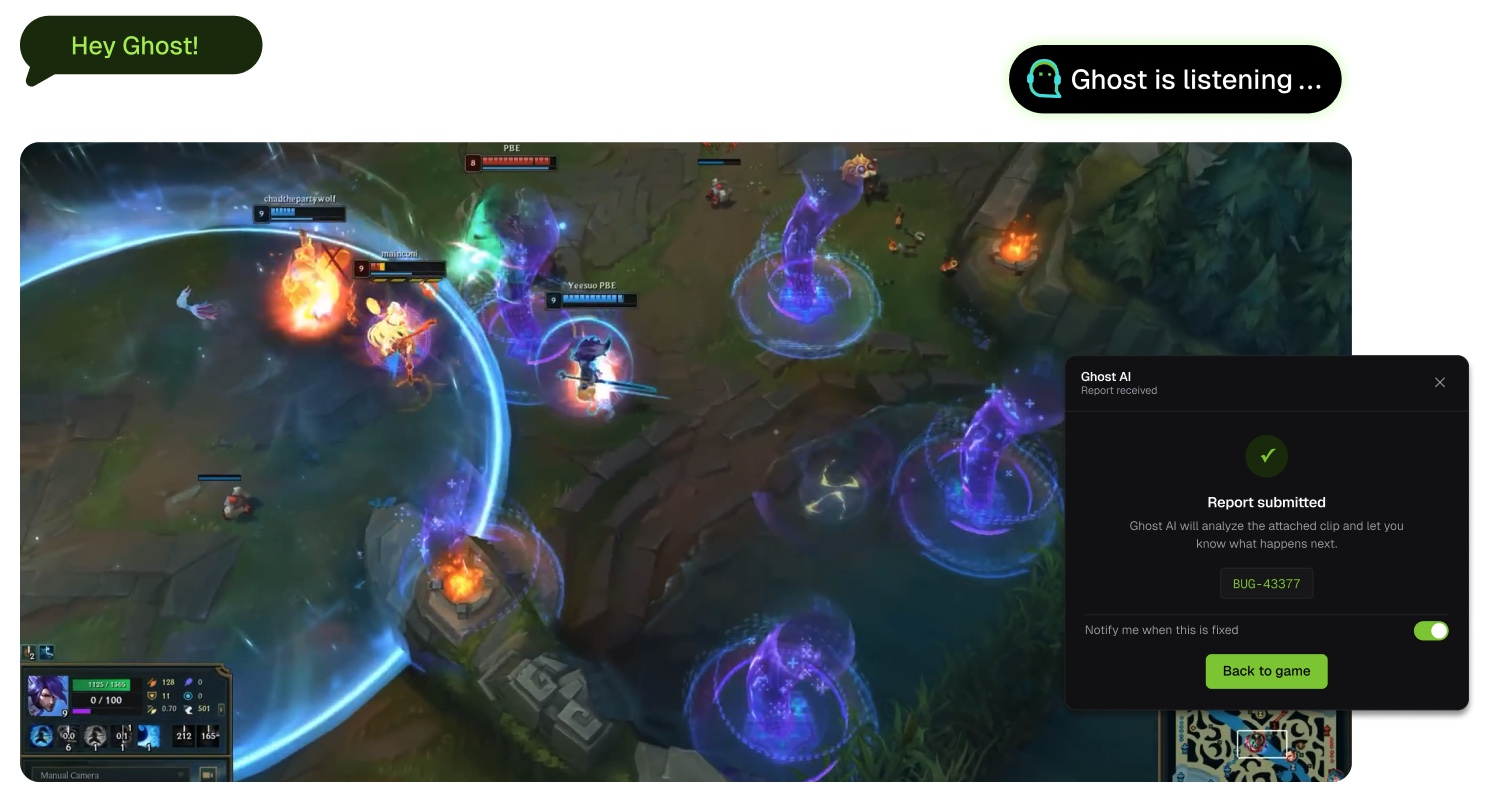
Players say “Hey Ghost” to report an issue without breaking their flow. The system captures the screen, system setup, and timestamp, then transcribes and structures what the player actually said.

Ghost AI is a feedback intelligence system that collects player reports by voice and turns thousands of scattered reports into a ranked actionable list.So players are heard and developers know where to start. No one gets ignored.
With a quick “Hey Ghost,” Ghost AI auto-captures the moments before and after a bug appears, analyzes the exact game state, and sends it straight to developers—who can step into that same setting themselves. No repro steps to write. No guessing what changed. Just the bug, exactly as the player experienced it.
Players report bugs into a dozen different channels. Studios manually sort, triage, and prioritize all of it by hand—with no shared system connecting a player’s voice to a developer’s next move. The gap isn’t collection. It’s everything that happens after.
The research behind every decision—across players, communities, and studios.
I triangulated player behavior, community discourse, and studio operations. Each phase resolved a different uncertainty and shaped what we investigated next.
Question: Where is AI useful—and where is it merely crowded?
We mapped six places AI was already reshaping gaming—matchmaking, onboarding, NPC behavior, content generation, anti-cheat, and LiveOps. Five were already crowded with funded competitors. LiveOps—the ongoing work of running a game after launch—was the one area with real player pain and no dedicated AI tooling at all. That gap is where Ghost AI started.
To understand where the gap lived, I examined how Riot, Xbox, Valve, Bungie, and Pearl Abyss described their feedback and bug-triage processes. The same pipeline kept appearing: community intake → classification → investigation → prioritization → engineering → player-facing closure.
The opportunity was not another way to collect feedback. It was the missing translation layer between what a player reports and what a studio can act on next.
Question: What keeps players engaged—and what breaks the relationship?
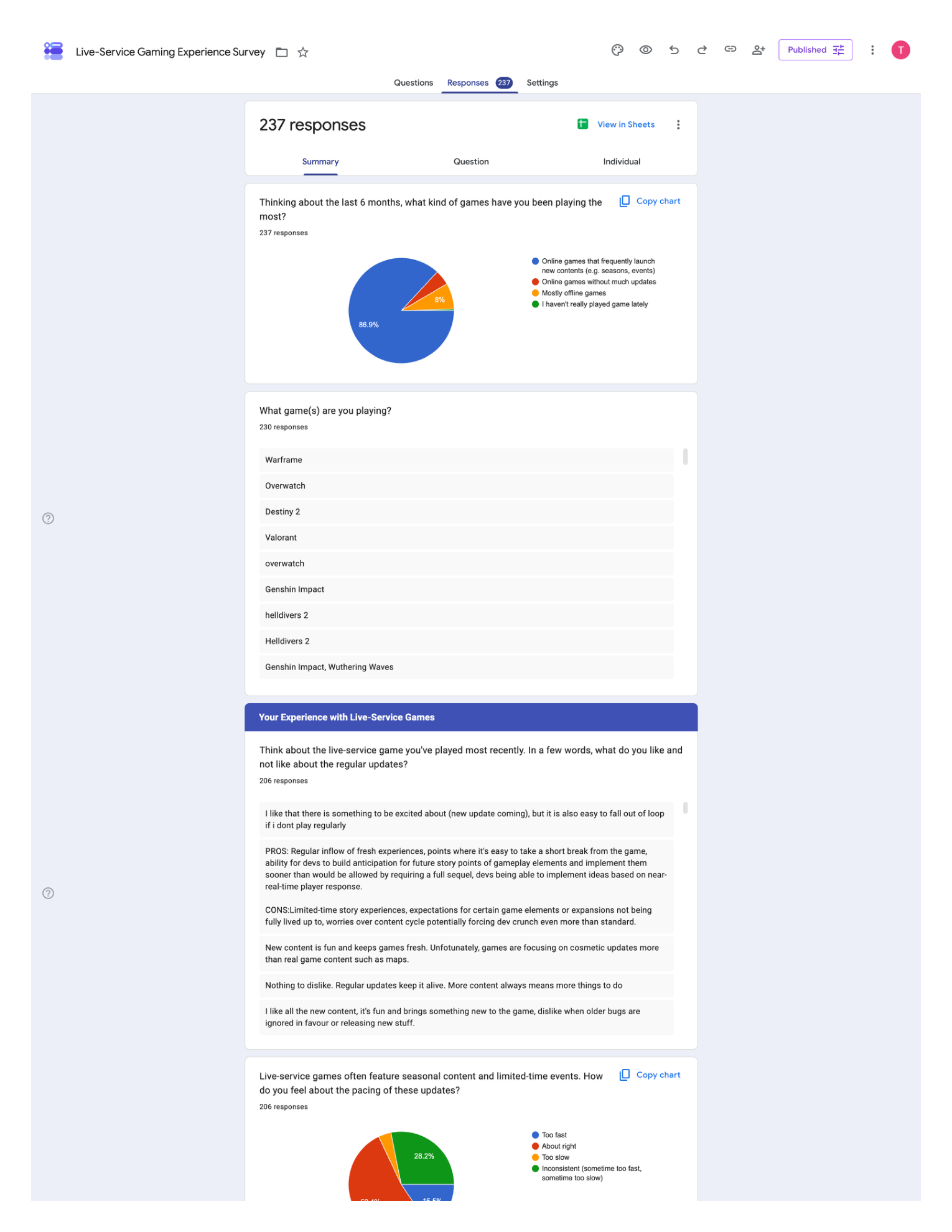
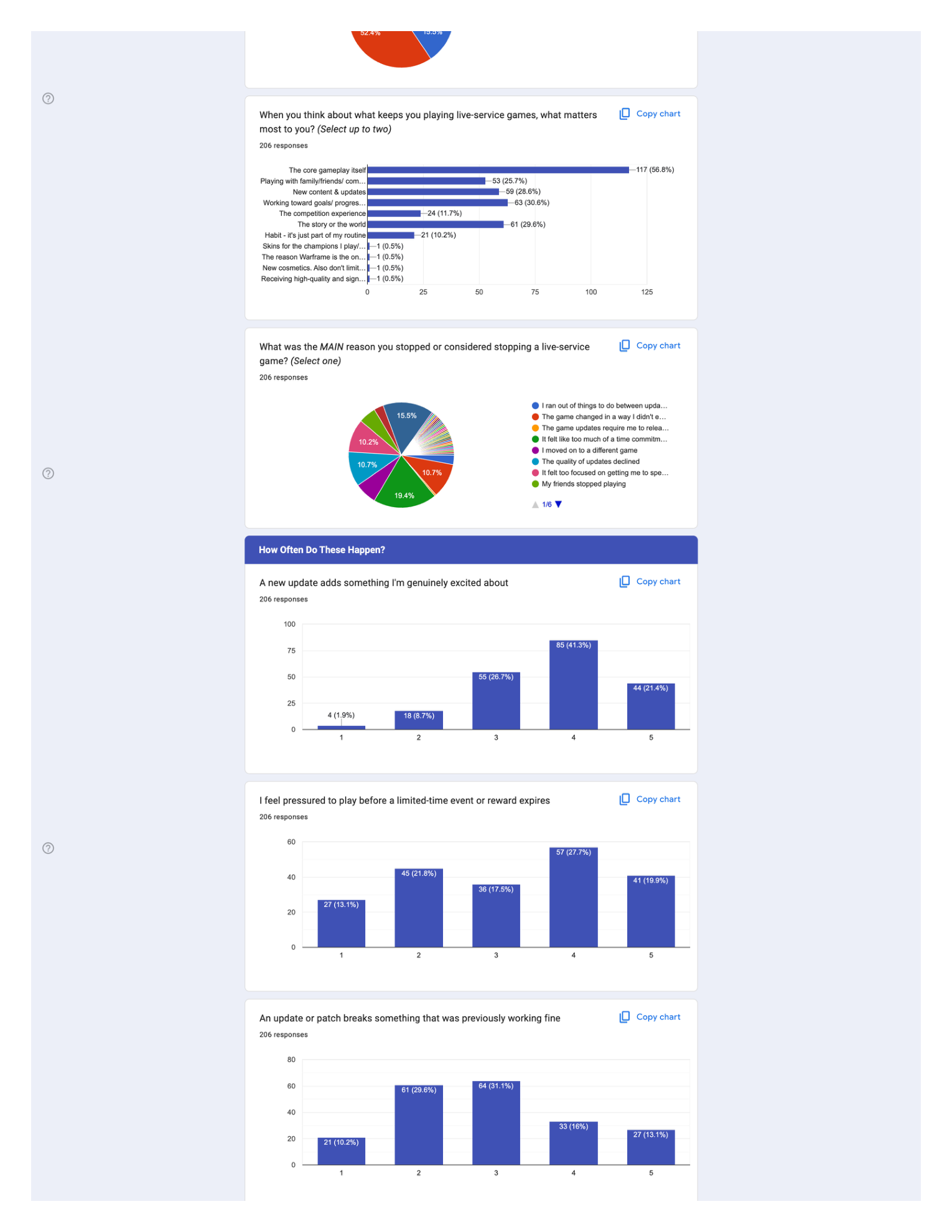
I designed a 10-question survey and distributed it through 15+ gaming communities, Discord servers, LinkedIn, and personal networks. To reduce bias, I placed open-ended questions before structured ones, randomized multi-select answers, and required a single choice for the quit-trigger question.
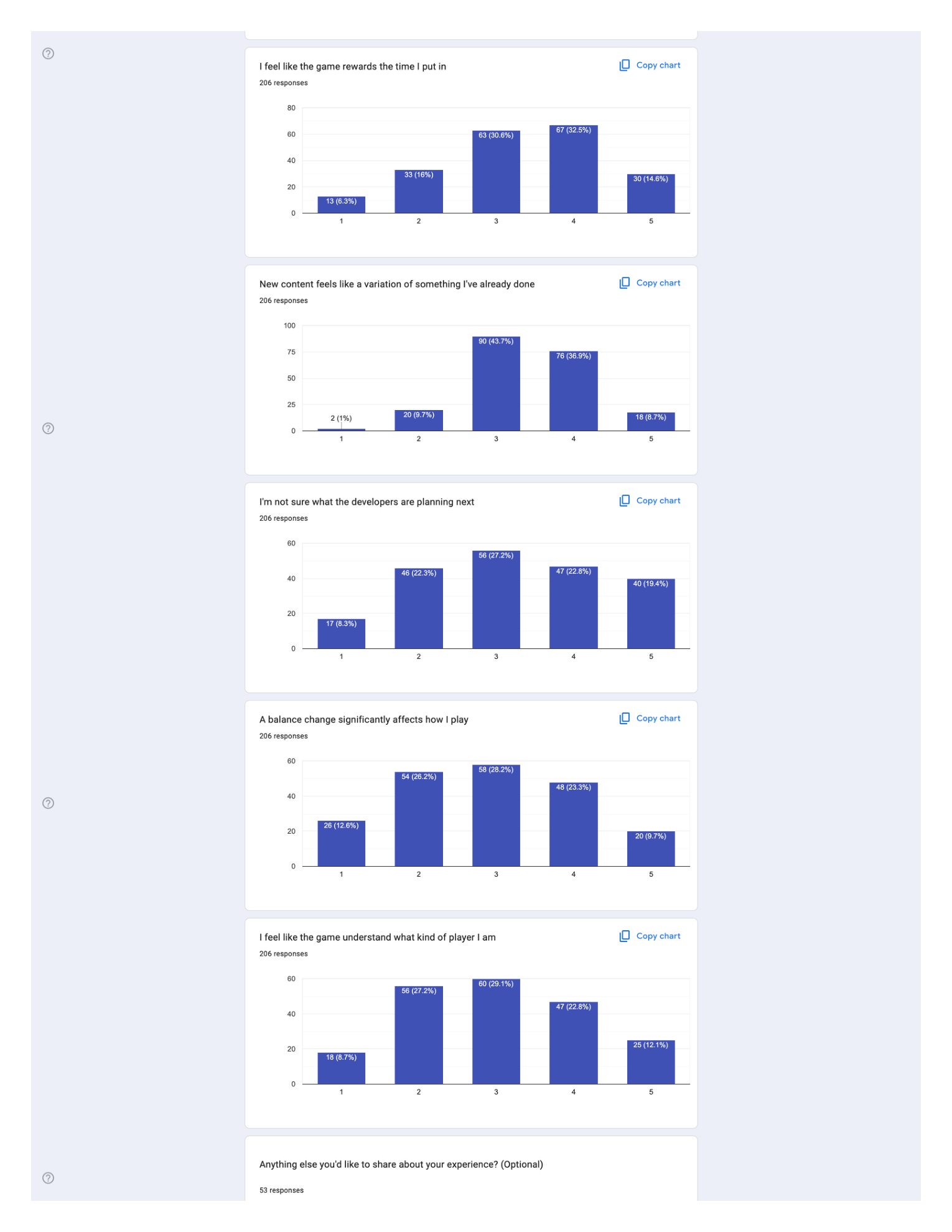
Among 200+ responses, 57% cited core gameplay as the reason they kept playing. Developer trust was the strongest open-ended theme. Personalization had the strongest relationship with feeling rewarded (r = 0.457, n = 191), and 66% of self-reported churn was actionable according to respondents.
I then reviewed 17 Reddit threads to deepen what the survey could not capture, including four FOMO subtypes and the “safety to leave” retention pattern associated with games such as Warframe.
The opportunity was larger than issue collection. Players’ continued engagement was tied to whether they felt the studio listened and responded.
Question: Why do studios struggle to act on feedback they already have?
I planned and conducted six interviews across studio sizes and roles. Each guide was customized to the participant and iterated on prior sessions, so later interviews could probe contradictions and gaps rather than repeat a fixed script.
I recorded, transcribed, and coded interviews around feedback collection, business-versus-design tension, trust, tooling gaps, and attitudes toward AI—allowing the team to compare a 2-person studio with a publisher serving 20M+ monthly players.
Every single participant, independently and without prompting, described some version of the same structural gap—feedback is not hard to collect, but translating it into prioritized, cross-functional action is almost entirely manual. This convergence across radically different studio scales was the strongest evidence signal of the entire research phase.
Question: Which patterns hold across players, communities, and studios?
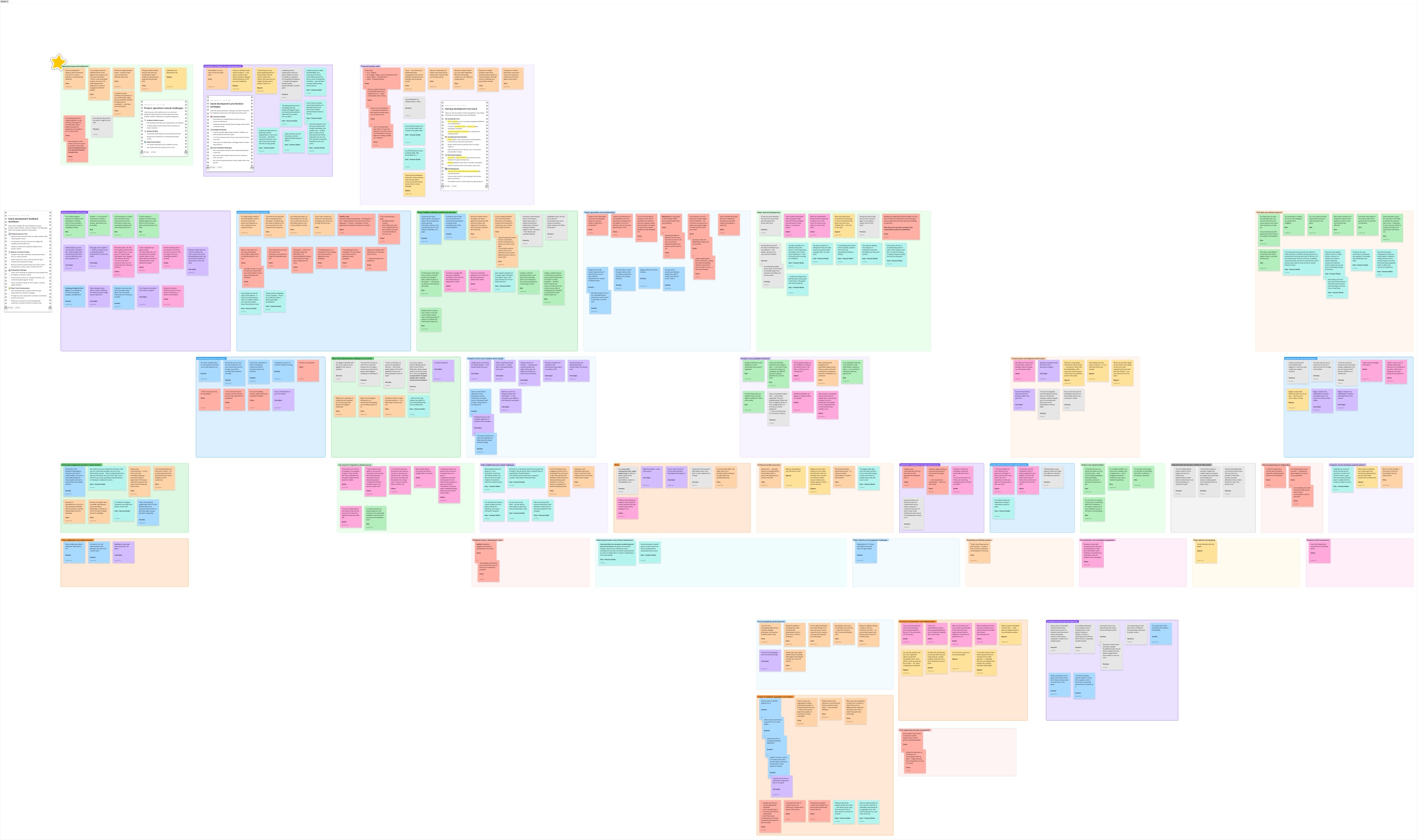
I combined survey results, Reddit findings, and all six interview transcripts in one affinity map. This made it possible to examine where evidence converged, where it conflicted, and which needs were consequential enough to shape the product thesis.
This synthesis directly shaped our product thesis and was presented to industry advisors as the evidentiary basis for our design direction.
Connect fragmented player signals to context-rich, cross-functional studio action—while keeping player trust central to the system.
Question: How much analytical depth helps teams without displacing creative judgment?
Before finalizing a design direction, I facilitated a structured co-design session with one of our SME participants, walking them through a storyboard of the envisioned experience and a working in-game report prototype, then giving them unstructured time to sketch their own ideal version of a studio-side dashboard.
The participant cautioned that over-reliance on analytics dashboards could become a “slippery slope” that erodes creative intuition.
Use a simplified default view with progressive disclosure into deeper data rather than presenting a dense dashboard all at once.
Question: Can players report fluidly, and can studio teams turn the result into action?
With a working prototype, I planned and moderated four usability testing sessions (one individual, one joint dual-participant session) walking participants through both halves of the product: the in-game voice-activated report flow and the studio-side dashboard, including a novel “impersonation mode” letting developers step directly into a player’s reported game state. Sessions used think-aloud protocol throughout, plus targeted scenario tasks (e.g., “200 players reported a similar bug over the weekend—walk me through how you’d make sense of it”).
Findings meaningfully changed the design rather than merely validating it. Multiple participants, independently, identified that a single unified dashboard was trying to serve incompatible roles—one participant noted plainly that “very few companies have the same person fixing bugs and investigating data.” The same participant’s single sharpest, most emotionally charged pain point—bugs routinely assigned to him that he had no ability to fix, with no system to route issues to the correct owner—became a headline feature requirement for the next design iteration.
Design for role-aware workflows and issue routing. Across all sessions, reinforce one non-negotiable constraint: AI may surface and suggest, but it must never decide or act autonomously.
With the problem defined, the next step was translation: preserve the context behind each report, support role-specific studio workflows, and keep AI assistive rather than autonomous. Those criteria shaped the product decisions that follow.
Ghost AI captures player reports in context, consolidates scattered feedback for studios, and closes the loop when issues are resolved.
Players say “Hey Ghost” to report an issue without breaking their flow. The system captures the screen, system setup, and timestamp, then transcribes and structures what the player actually said.
Ghost clusters reports and qualitative feedback from multiple channels into issues and themes, ranks them by impact, and lets studio teams examine trends through an AI assistant.
Instead of interpreting a vague report, a developer can inspect the reported game state—including environment, player level, experience, and items—to understand what the player experienced.
Teams can move between task and feedback views, adjust AI-supported synthesis, and prioritize work. When a fix is made, the player is notified rather than left in silence. Testing made issue routing a requirement for the next iteration.
AI should suggest, not decide.
This principle came directly from SME interviews and co-design. Participants wanted AI to reduce manual synthesis and surface meaningful patterns, but warned that overreliance on analytics could erode creative intuition. Usability testing reinforced that prioritization and routing require role-specific context and accountable human judgment. Ghost AI therefore organizes evidence and recommends next steps while people retain control over interpretation, prioritization, and action.
The work followed a clear line from evidence → decision → product response, moving the team from an unscoped prompt to a tested product direction supported by quantitative, qualitative, participatory, and evaluative evidence.
Research gave the team a reason to build, a model for what to build, and constraints for how AI should behave.
The most important methodological decision in this project was triangulation across radically different vantage points—a 2-person indie team, a mid-size mobile studio, and a publisher managing millions of monthly players—rather than optimizing for depth within a single studio profile. It was the convergence across that range, not any single strong data point, that gave our design direction its credibility.
The usability testing phase reinforced a lesson I try to carry into every project: the sharpest, most valuable insights are rarely the ones you asked a direct question to get. Our single strongest feature requirement—bug routing—emerged unprompted, mid-conversation, from a participant working through a scenario task. It was a reminder that think-aloud protocol and scenario-based testing consistently outperform direct questioning when the goal is surfacing insights participants do not yet know how to articulate as feedback.
Evidence boundary: this case study reports research and prototype outcomes. It does not claim production adoption or post-launch business impact.
Software should not become a barrier between people. It can help build connection and trust.